

Flylab Interview: Jackson Riegler
The Oshki founder on Great Lakes conservation, building something from nothing and the next generation’s impact on fly fishing.


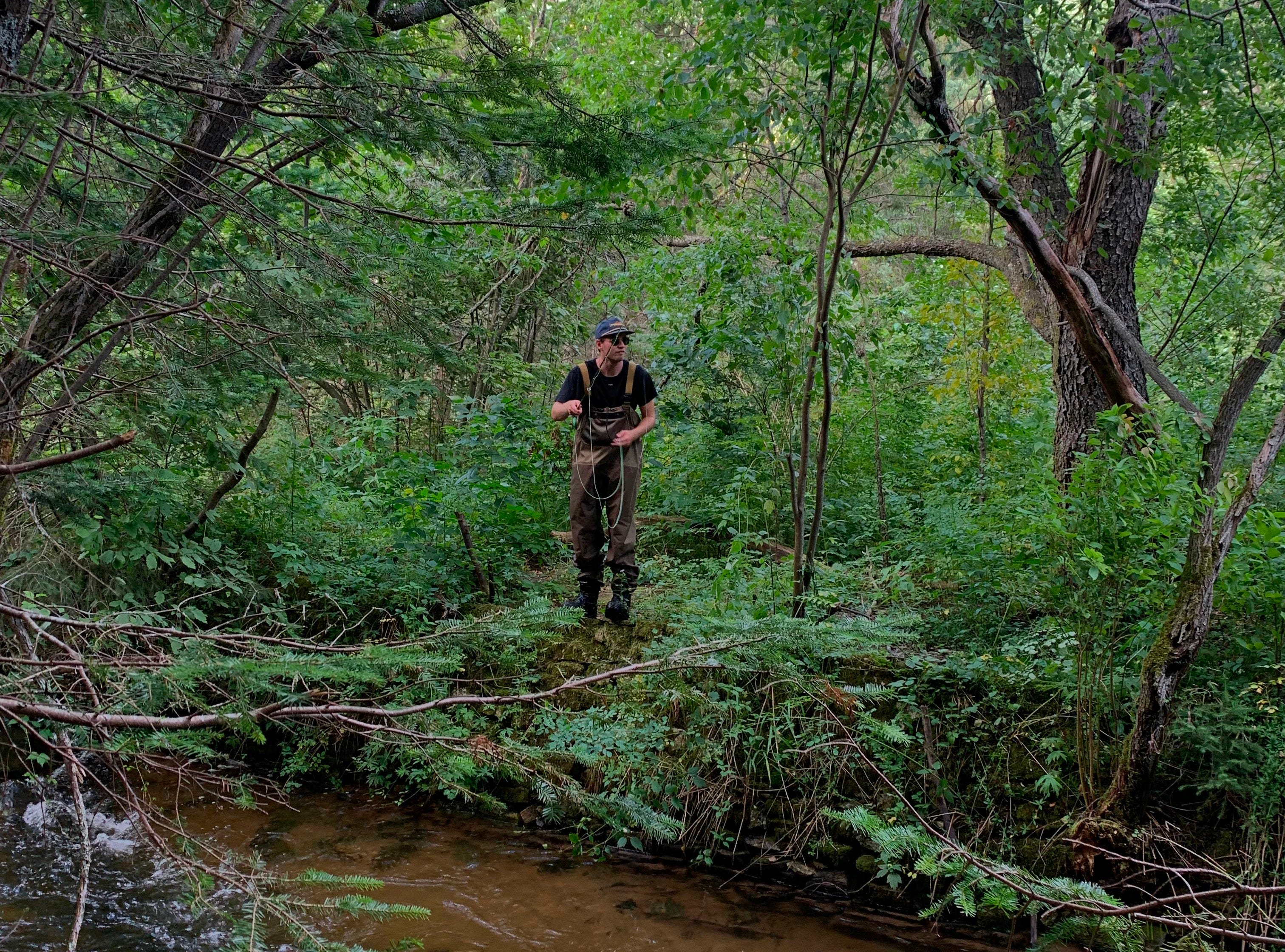
Jackson Riegler is the future of fly fishing. He’s an entrepreneur, conservationist and fellow midwesterner from Muskegon, Michigan. At 17, he started Oshki, a sustainable apparel brand built with Great Lakes conservation at the forefront. In just 8 years, what began with $500 saved up from a summer landscaping job became a nationally recognized brand. He raised over $600,000 for coldwater conservation through two co-branded campaigns with Trout Unlimited, organized more than 30 beach cleanups and transformed over 160,000 plastic bottles’ worth of waste into clothing. In October 2025, he closed Oshki due to tariff pressures and rising costs that made the business impossible to sustain. He’s 26 now and already making his next move.
Take me back to your childhood. How did you become an angler?
It started with panfish on ponds near my grandpa’s house. I grew up catching frogs, searching for what lived in the water and coming home with mud under my nails. It was just what you did growing up in Michigan. Water is everywhere out here: inland lakes, rivers, the Great Lakes themselves. It was never really a hobby, just a way of life.
I found fly fishing later, and it changed everything. It slowed me down. It made me pay attention to things beyond catching the biggest fish. I really started to tune in to everything around me when I was on the water.
Growing up on the Great Lakes–did you know early on that you wanted to advocate for them?
Not consciously, but you can’t grow up there and not see it. You watch the lakes change. Algae blooms, plastic on the shoreline, invasive species, those were just realities of my childhood. Muskegon specifically has a complicated industrial history. It has shifted from a manufacturing economy to a recreational one. Growing up, it was easy to see what happens when people stop caring about the resource. Because of that, conservation started feeling important pretty early.
Regardless of where people grew up, I think a lot of folks in our generation share some version of that experience. Since we were young, we’ve been told: you should have seen the fishing 10, 20, 30 years ago! You hear that enough, and it starts to get to you.
You started Oshki at 17 with landscaping money, specifically in response to Great Lakes Restoration Initiative (GLRI) budget cuts. Why?
I was reading about federal conservation funding getting cut and it genuinely made me angry. I was 17, fishing those waters, and someone in Washington was deciding they weren’t worth protecting. I didn’t have a business plan. I had $500 and a belief that people my age cared about this if you gave them a reason to.
Looking back, I was naive in the best way. I didn’t know enough to be scared of how hard it would be. But I also think that naivety is sometimes an asset. If I had known all the problems and challenges I would face, every logistical nightmare, the sheer exhaustion of being a solo founder, I’m not sure I would have started. So, maybe ignorance gets you in the door, and then some level of stubbornness keeps you there.
You did a partnership with TU that raised over $600,000. How did that work and what did it feel like to raise that much money?
It felt surreal and, honestly, exhausting in the moment. The true meaning of it hit me later.
The partnership worked as a fundraiser for the Great Lakes, in which an Oshki sun hoodie made from recycled U.S. plastic with TU branding was a donation incentive. By the end of two fundraisers, we had raised $600,000 for TU projects in the Great Lakes region.
What I remember most is the imposter syndrome. When you’re a small team–a two-man show with my longtime friend and artist Jimmy Cobb and me–you’re looking at yourself in the mirror every day, wondering if you’re capable. But then you’re suddenly working with a national organization, fulfilling 15,000 custom hoodies and connecting with hundreds of thousands of people. It felt like the idea had become real in a way I hadn’t fully anticipated.
More than anything, it taught me the power of storytelling. Those donors weren’t buying hoodies, they were buying an idea. A kid from Muskegon, a scrappy start-up, plastic pulled off Great Lakes beaches turned into something you could wear. That story worked. And that’s when I really understood that without a compelling why, nothing else matters.
You closed Oshki after eight years–walk me through what happened.
Two contracts collapsed at once because of tariff impacts. Years of savings evaporated in a few months. Each hit on its own would have been manageable, but together, they became impossible to deal with.
In the moment, it felt like a failure. Later on, when I had enough distance to see that I’d built something real and made a deliberate choice not to destroy it by taking on debt, my thinking began to change.
There’s definitely grief in the whole experience. Eight years is a long time to have to let go of something.
Another element I’ve had to wrestle with was the feeling of being a young person who was told that this was his time to shine. Then, the very policies that were supposedly going to help small business owners like me became the thing that destroyed us. I’m not trying to make it political. I started a business with my own money to do something I cared about. I just wish that story had a happier ending.
What did you learn?
The story is everything. As I mentioned earlier, without a compelling why, nothing else matters. Product, partnerships, media, all of it flows from a narrative.
That being a solo founder is a superpower and a liability at the same time. You move fast, and you break from exhaustion.
Finally, conservation needs people who can speak business, and business needs people who actually care about something beyond margins. We’re getting closer to seeing those two worlds meet, but there’s still a lot of work to do.
When you’re on the water, what are you there for?
Presence. It’s one of the only places where my brain stops thinking about the next ten things I should be doing. Reading water demands your full attention. Surprisingly, the fish have become secondary in a lot of ways. Lately, I find myself birdwatching and searching for amphibians just as often as I’m fly fishing.
I was reading some John Gierach recently, and there’s a passage where he’s been chasing a specific hatch all spring. Finally, the perfect conditions arrive, and then he comes across an injured bird on the bank. He stays with it and lets the hatch pass him by. I found that really moving. Here’s someone who has spent a lifetime catching fish, and in that moment, the fish just wasn’t the point. I think that’s where a lot of us are heading, honestly. Fly fishing is just the door to something much bigger.
What does fly fishing get wrong about the next generation of anglers?
It’s too focused on aesthetics. The gear, the vocabulary, the unspoken rules about how you’re supposed to look doing it, all take up too much real estate. The next generation doesn’t care about tradition for its own sake. We care about the experience, the place and the people.
I also think the conservation story is undersold in fly-fishing culture. There are a lot of spaces in this world where organizations stay “apolitical” to avoid ruffling their customer base. Most young anglers I know care deeply about water health. To our generation, staying quiet reads the same as taking the wrong side.
The current fly-fishing culture just doesn’t seem to understand that. You’ve got this built-in audience of people who wade into rivers they deeply care about, and the conversation keeps defaulting to what fly rod they’re throwing.
What excites you in the outdoor world right now? What concerns you?
What excites me is that the gap between outdoor recreation and conservation activism is narrowing. People who fish are showing up at public lands hearings. Younger anglers and more diverse audiences are reshaping the culture from the inside, not waiting for permission.
Something that concerns me is access. Public land pressure is real and the political appetite to protect it feels shakier than ever.
Then, there’s water scarcity. People aren’t paying enough attention to what large-scale water usage–data centers, industrial agriculture, etc.–is doing to the water table. We’re entering a new era of water demand, and that’s going to affect every single one of us.
You mentioned that conservation needs people who can speak business, and business needs people who actually care beyond the margin. Who’s doing that well?
Sadly, it’s getting harder to answer that question with confidence. We watched a lot of companies that claimed conservation values bend pretty quickly when the political winds shifted. So, I’m less interested in pointing to brands and more interested in talking about programs like the Erb Institute at the University of Michigan. They operate at the intersection of the business school and the environmental school. That’s the kind of program the conservation world needs: people who can walk into a boardroom and a nonprofit meeting and be credible in both rooms without having to code-switch their entire identity.
That was something I struggled with at Oshki. One day, I was talking to a Great Lakes nonprofit about long-term vision. The next, I was in a big-box retailer pitch where none of that matters, and it’s all margin and unit economics. We need more people who don’t have to choose between those conversations.
What’s next for you?
I’ve started doing some work with Trout Unlimited on their digital storytelling, which is fun because it grew directly out of the TU - Oshki partnership.
Longer term, I’m looking for a role inside a mission-driven organization where I can bring the same energy I brought to Oshki but as part of a larger team.
And of course, I’m staying close to the water. Whatever comes next, that part will never change.
Jackson Riegler is based in Michigan. You can contact him @ jacksonriegler@gmail.com.
Also, if you’re a next-generation angler, we’d love to hear from you. Shoot me an email @ watsoncliff23@gmail.com to share your thoughts and join our WhatsApp group.
Cliff Watson grew up in Wisconsin and now roams the Western U.S. like many other displaced Midwesterners. He has fished commercially in Alaska, hitchhiked with a fly rod through South America and developed some thoughts along the way. He writes about fishing, culture and the human experience. Give his Substack, Kudos, a follow. You’ll be glad you did.
 | A guest post by
|
Smart, important observations, and wisdom, too. Thank you for this interview.