

Why Carp?
Carp do a worthy job of demanding all the skills an angler can muster.


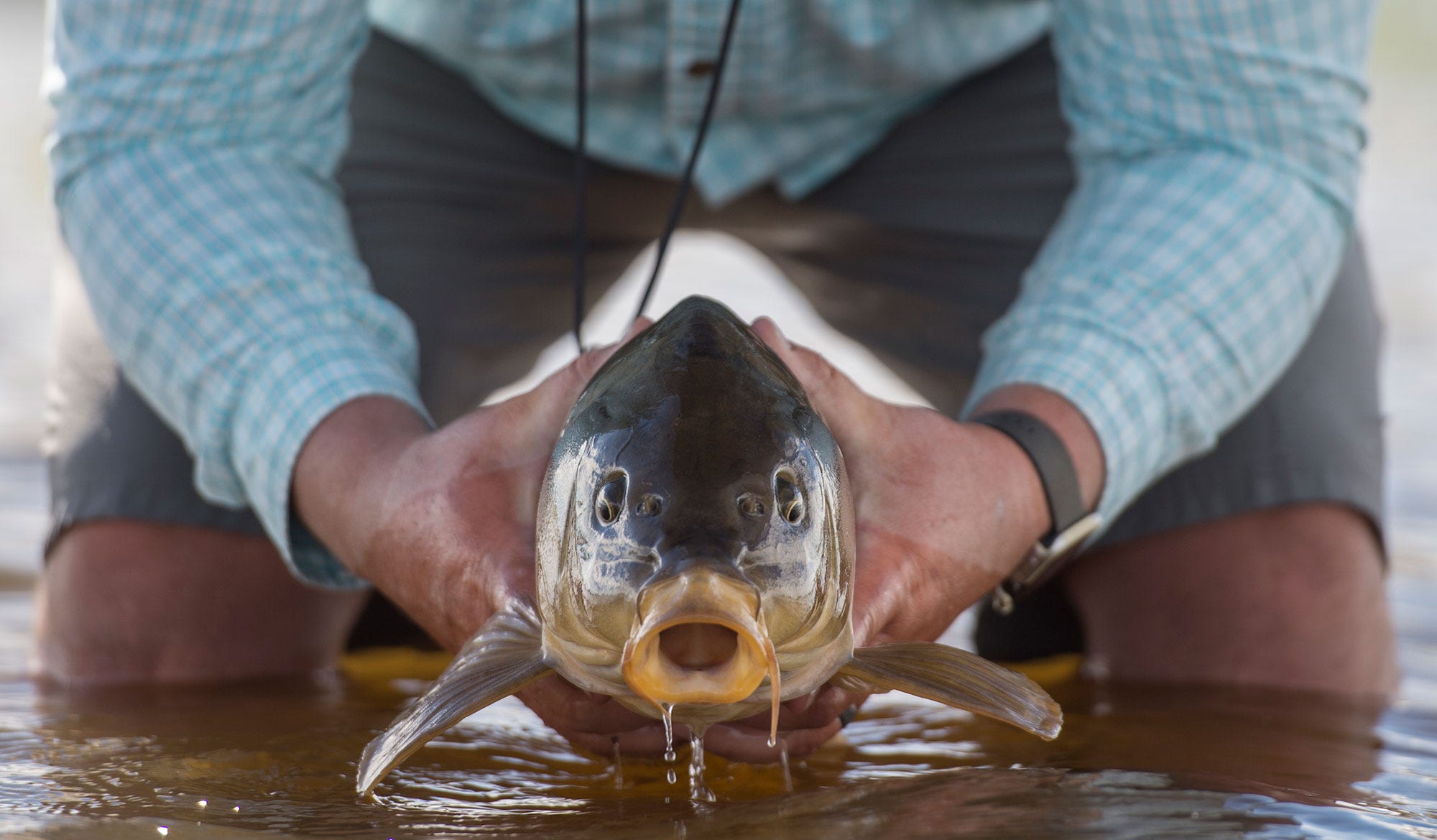
When I told my mother I was writing a book on fly fishing for carp, her first response was, “Why would you do that?” She related a childhood story of how she hooked a carp while fishing with her father below the Independence Dam in Defiance, Ohio, and he laughed and laughed as that big, ugly fish tugged her up and down the riverbank.
Back then–and to this day–the carp is considered by many anglers to be an unfortunate result. It’s the fish you hook by accident. Most people certainly wouldn’t think of eating carp (at least not these days). And to target carp intentionally with a fly rod, rather than a bow and arrow... well, that’s just nuts.
Unless you really like to fly fish. And unless you really want to get good at fly fishing.
There is no doubt that the fly-fishing world spins on the axis of trout. Most of us start with trout. Most of the companies that make and sell things like rods, reels, lines and other gear would not exist were it not for trout.
Saltwater fly fishing is almost an entirely different sport than fly fishing for trout. Same basic tools, totally different approach. On a trout stream, presentation is paramount. How the fly behaves after it hits the water is as important as, or more important than, the cast you make to get it there in the first place. In the salt, on the other hand, a great cast (long and accurate) is usually the price of admission.
We can debate the importance of other factors like the angler’s ability to read water, and fly pattern selection and the other intangibles that go into various types of fly fishing until we’re blue in our faces. I’ve heard those conversations over and over. And my short answer is that all of it is important. No angler has ever suffered by having a great, accurate cast. You might not need to throw a fly 80 feet all the time, especially not on a trout stream, but it’s pretty nice to have that distance in your arsenal. You don’t need to be an entomologist or a marine biologist to decide on the right fly, but the more you understand what fish actually eat, the more fish you catch.
And it never hurts to be able to spot fish and understand the subtle telltales that indicate where they will be at any given time.
Which is what brings me back to carp. Carp do a better job of demanding all the skills an angler can muster–from the accurate cast, to spotting fish, to picking the right bug, to dropping that fly right into the feeding zone at exactly the right moment and making it behave just so–than almost any fish you can chase with a fly rod.
This chapter is excerpted from The Orvis Guide to Fly Fishing for Carp: Tips and Tricks for the Determined Angler (2013).
Also, check out KD’s new book: A Fishable Feast: Fly Fishing and Eating Your Way Around the World–out this year and published by Rizzoli in New York. (order at Amazon, Barnes & Noble, Books-A-Million.) If you want a personalized copy with an inscription from me for yourself or a gift recipient–e.g. “to Susie, the greatest fly angler ever to grace the rivers of the Americas”–sure, I’m game. Just visit kirkdeeter.com to order and tell me what you want me to write.
 | A guest post by
|
I learned to fly fish two years ago and have only caught two trout. I have to go to the Driftless Region in Minnesota to do so, and I don't live very close. However I do have access to the lake across the street from me. I caught this 18 inch Largemouth Bass the other day as well as a 14 inch one. I have also caught Crappies, Sunfish, and a Bullhead. No Carp yet, but would happily do so. I've improved my casting, line control, and landing of fish. And had a ton of fun! I can see how the Carp would be a blast to catch. All fish released after quick pictures.