

The Confusing Road to Casting Pond Glory
When it comes to testing rods at fly-fishing expos, every uninterested eye counts.


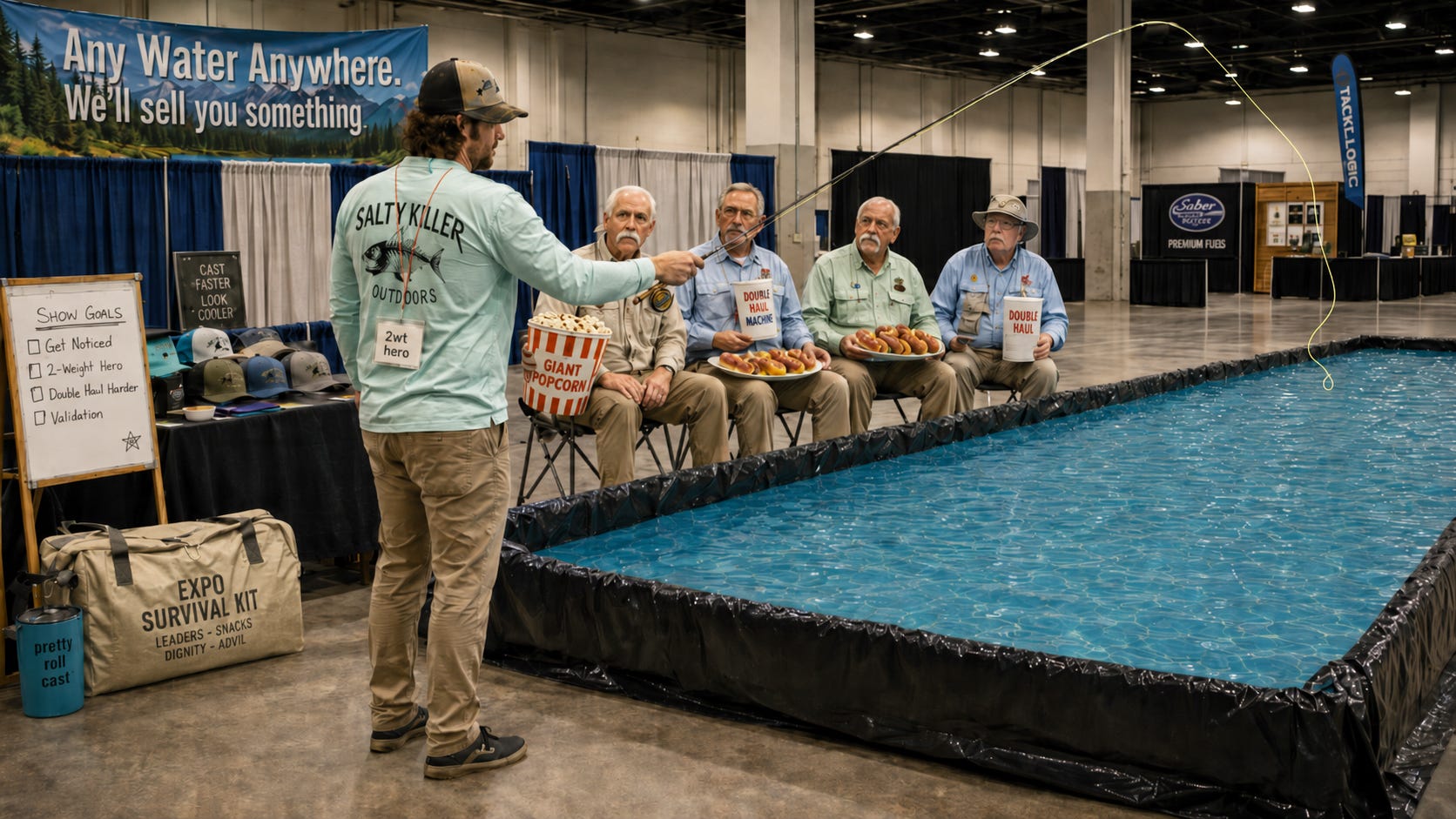
I have so many questions for Jeff Colvin, but I do not want to interrupt his process. I just sit quietly in the corner of his room at a Holiday Inn Express in Denver with a notebook and watch him pace back and forth at the foot of the bed.
He’s been up since 6 a.m., figuring out his wardrobe and, with go-time fast approaching, he’s stuck on the hat. According to Colvin, it’s the most important part of his outfit because it’s the most visible. If he goes with the Scientific Anglers mesh back, he worries he could lose eyeballs from anyone at RIO or Cortland. But, if he opts for the Howler Brothers snapback, he fears his core fans will assume he’s gone unnoticed this season by any major brands that produce technical fly gear. His blood pressure is rising.
Across the street at the Denver Mart, the doors of The Fly Fishing Show have just opened and gobs of winter-weary anglers are flooding in, eager to grab information about lodges they’ll never visit and pay full retail price for everything they buy. This event is Colvin’s Super Bowl. He has been traveling the country since November visiting every fly expo from Massachusetts to California with one goal–dazzle as many spectators at the rectangular casting pond as humanly possible.
For all intent and purposes, this is Colvin’s sport and as far as he’s concerned, he’s playing at a professional level. He’s not a guide, certified casting instructor, writer, or influencer. He’s just a 35-year-old financial adviser from Ohio who is addicted to casting fly rods in front of strangers. As I shadowed him for months on the long road to Denver during the 2025/2026 season, I never expected the loops being thrown my direction to be so loose and confusing.
Roll Out the Validation
“Pretty roll cast.”
Those three little words changed the trajectory of Colvin’s life, he explained the first time we met at a repurposed Cincinnati carpet factory that now sells $40 gourmet burgers and makes you sit on low wooden crates to eat them. He’ll never know the name or even the face of the man who lofted the compliment, but the power it injected into his fly-fishing soul has been driving him since that fateful day in 2016.
“I was only 25 at the time,” he said as he wiped black garlic-rose water aioli out of his handlebar mustache. “I was legitimately at the show to buy a new rod, and back then I didn’t have a lot of cash, so I really wanted to make sure I was spending wisely. I grabbed this Loomis and timidly took it to the pond. I was nervous, so I just started roll casting and out of the corner of my ear I heard it. I don’t know, man. It was like attaining Nirvana. I looked down to the end of that hula hoop filled pool and realized this is where I was meant to be.”
By the end of that day, Colvin had tested almost every rod in the building, looking for another hit of that sweet casting skill validation. Over the last decade he’s had his hands on thousands of rods. But when I asked him which one stood out the most, I was shocked by his answer.
“None really come to mind,” he said. “To be honest, it’s like if you know how to cast well, then you can do it with a $50 rod or a $2,000 rod. It makes no difference. The truth is ninety-nine percent of my competitors at these shows aren’t paying attention to the rod. And they’re certainly not going to buy one. They just want to cast in front of people. They just want to be seen, you know?”
It made an iota of sense at the time, but a month later at the Lancaster Fly Fishing Show I was perplexed. This was the first chance I’d gotten to see Colvin perform live, and after making some poor kid at the Sage booth track down a reel loaded with 2-weight line, because he insisted on testing the lightest rod in the company’s arsenal, I wasn’t convinced Colvin was being seen at all.
As he cast, I circled the pond and eavesdropped. Never once did I hear a single passerby comment on Colvin’s ability. In fact, I barely saw an eye shift in his direction. At one point, a man approached me along the pond barrier. I assumed he was coming to watch Colvin, but he just wanted to know if I knew which booth had the buy-one-get-one deal on egg yarn.
Yet, to my surprise, when Colvin left the pond, he was thrilled.
“They were feeling that,” he told me. “You don’t see a lot of guys out here with a 2-weight. Small rods get the looks. It’s like ‘let me show you what a $500 rod designed to dapple shit in front of a dumb wild brook trout four feet away could do on a bonefish flat,’ right?”
As Colvin wandered off to track down a 15-weight rod and reel for his next performance, I felt like I was missing something.
If he wasn’t being fawned over by the spectators, maybe he was getting showered with the recognition he craved by the fly rod makers.
Show Stoppers
Over the next month and a half, I accompanied Colvin to the Atlanta Fly Fishing Show, Marlboro Fly Fishing Show in Massachusetts and Edison Fly Fishing Show in New Jersey. Along the way, I learned his system. The best time to cast is from one hour after the show opens until approximately 1 p.m. After that, crowds begin to taper off and celebrities are wrapped up with seminars, making it less likely they’ll see Colvin doing his thing. The biggest highlight for him at all three events was when Tom Rosenbauer briskly walked by talking loudly on his cell phone as Colvin was double hauling.
I spent most of my time interviewing people at rod company booths about Colvin, only to learn nobody really knew him. Most commonly I’d just get, “Who?” Occasionally, I’d hear, “Oh, that guy.” In Atlanta, when I described who he is and what he does to the young man at the Thomas & Thomas booth, he said, “No clue who you’re talking about. You’re describing thousands of dudes we see at these shows during the winter. Every five seconds I’m walking another guy in Free Fly joggers over to that pond with a rod he won’t buy, so he can flail it around while his girlfriend films for his Instagram stories.”
The more time I spent with Colvin, the less I understood about what he was doing.
To my eye, this was all thankless. Between plane tickets and hotel rooms and the price of the terrible pulled pork sandwiches served at the shows, he was spending a lot of money. As we walked into the Denver Fly Fishing Show, I could sense his nervous anticipation, but I couldn’t figure out why this event would be so different, and for the first few hours, it wasn’t.
Throngs of people passed by during Colvin’s sessions, paying him no mind whatsoever. But then around noon it happened. I caught a look of disbelief from Colvin as he nodded his head to the right to draw my attention to an older man wearing a visor staring directly at him. I’d later find out it was Andy Mill, who, with arms crossed and a blank gaze, watched every stroke Colvin made. After about 20 seconds, another man approached Mill, handed him a foot long hot dog and soda, and they both quickly walked away.
Colvin was beside himself, nearly in tears. He raced out of the building to call his wife.
“Andy Mill, babe!” he yelled into the phone as he tried to catch his breath. “Andy goddamn Mill just stood there and watched me cast. Honestly, it was incredible…”
I congratulated Colvin because it seemed appropriate and then asked where he goes from here. Clearly, I had been present for a lifetime achievement.
“I don’t really know,” an elated Colvin answered. “Short of Lefty Kreh getting resurrected from the dead and standing there watching me dump the new Helios 4 down to the backing, I don’t think I’ll ever experience anything like that again.”
 | A guest post by
|
I once knew a true gentleman who used to do synchronized fly casting, under a spotlight, in front of massive audiences, to the music of a live orchestra. Those were the days ...
Don't pee in the casting pond
said nobody, until today.
Or is it a casting pool?
Guilty on both accounts.
(Great writing, Mr. Hands)