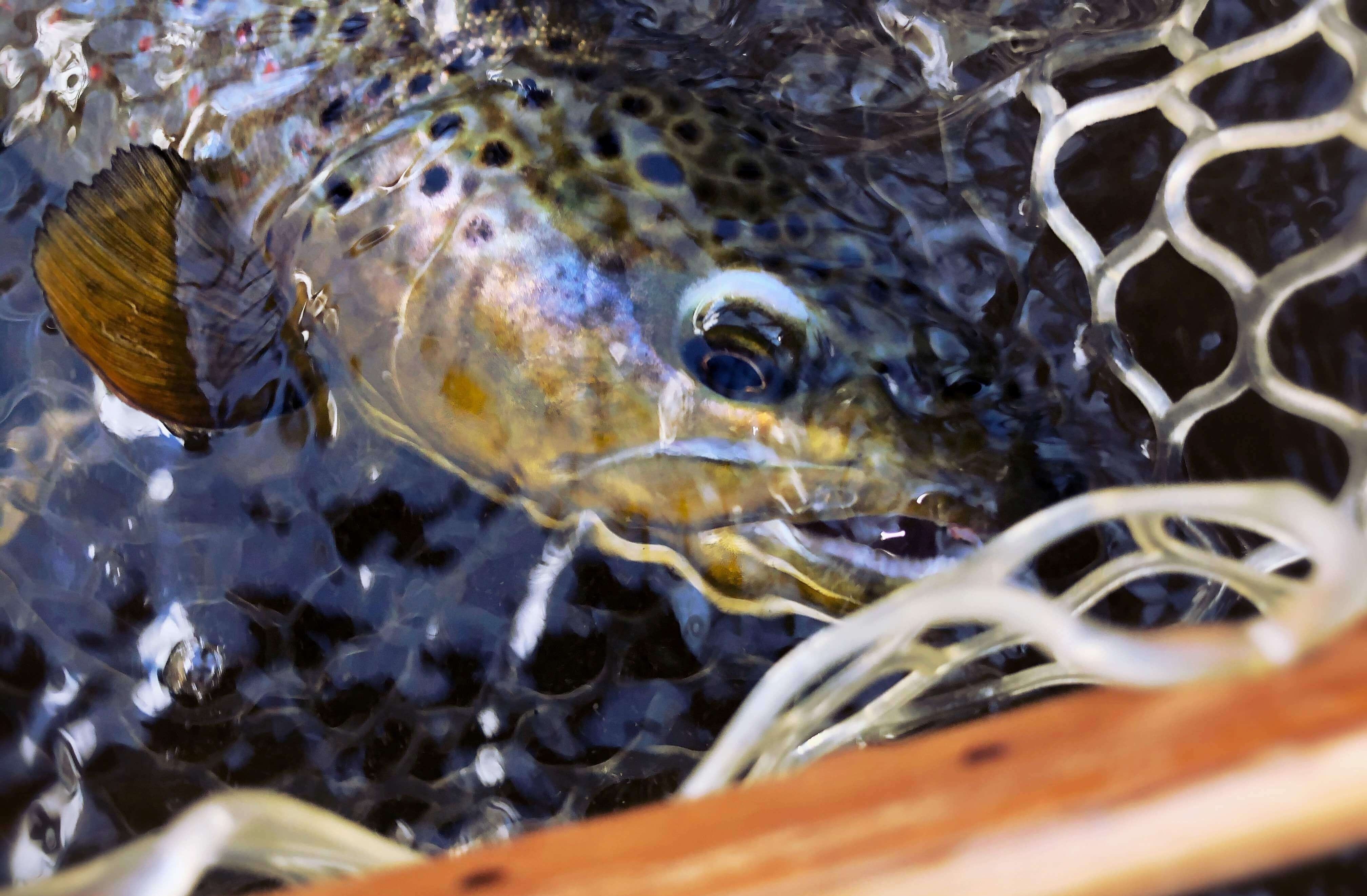
Photographing Fish
Do not remove the fish from the water until the camera is ready...
By John Juracek
Ever wished that your photographs of fish looked as pretty as the fish themselves? We probably all have. Here are some of the things I think about when photographing fish. Perhaps you’ll find value in them too.
Foremost in my mind is an appreciation for what the fish have provided in the way of sport. If I’m going to ask for their picture, as well as for the excitement of their capture, I feel a responsibility to accord them a certain measure of respect. I try to show them off in a pleasing manner. I try to make the photograph about them, and not about the angler or about me as the photographer. No hero shots, no funky poses, no unusual lens effects.
You may feel differently. If, for example, you would like to include the angler in your picture, think about having her look at the fish and not at the camera. Doing so directs attention to the fish, which is sort of the point. You can have your picture taken anytime.
Photographing fish by yourself is difficult. And it can be hard on the fish. It’s better to seek the help of a friend. Both you and the fish will be glad you did.
Focus the camera on the eye of the fish. If the eye is sharp, everything else in the photo–sharp or not–will appear acceptable. If the eye isn’t sharp, nothing about the photo will look good.
Do not remove the fish from the water until the camera is ready. Limit the time the fish is out of water to 3-4 seconds. If you wish to reshoot, put the fish back in the water between pictures.
Holding a fish with the front hand facing palm out and the back hand facing palm in shows off the fish in an attractive manner. Whenever a fish is held with two palms out it’s awkward looking, for us and the fish. And invariably, too much of the fish gets covered over by hands.
As much as possible, keep the thumb and palm of your front hand hidden behind the fish. Doing so provides an uninterrupted view of an important body line. Same goes for the fingers of the front hand; keep them out of view as best you can. I like the back hand as far back as possible while still supporting the fish. Try holding fish smaller than 16-inches in one hand. I think they look best that way.
Hold the fish no higher than an inch or so above the water. This is good for the fish in case it slips from the hands, and it also maintains a visual connection between the fish and its habitat. Isolate the fish from its environment and you’ll end up with a photo of–forgive me here–a fish out of water. Consider, too, getting the camera down to the fish’s level; it’s a more pleasing perspective than shooting from high overhead.
This isn’t everything involved with photographing fish, but it’s a start. Give these suggestions a try and I think you’ll find your pictures to be respectful of the fish and eye-pleasing to boot.
John Juracek is a fly fisherman, writer and photographer from West Yellowstone, Montana. For twenty-some years he was a partner at Blue Ribbon Flies, a local fly shop, and is currently the head casting instructor at the School of Trout and Anglers Academy. His writing credits include Yellowstone: Photographs of an Angling Landscape, Fly Patterns of Yellowstone, Fishing Yellowstone Hatches and Fly Patterns of Yellowstone, Volume Two.
He is considered one of the sport’s expert fly casters and instructors and offers casting lessons for $100/hour at jjuracek@gmail.com or (406) 640-2828.


This is such a great post. I always struggle with photographing fish and often end up just releasing the fish because I feel I can't get the photo in a way that does the fish justice and doesn't stress the fish more than they already have been. Also, and this probably goes without saying for most people reading this, it's important to have wet hands before handling the fish for the photo to protect the mucous layer.
Thanks!
Interesting article about a sensitive topic. I love taking (limited) pics of fish but I work very hard to minimize the impact on the little (or big) critters and I do have a hard time seeing too many hero shots (though I’m certainly not perfect). I tend to take my own photos of my own fish and I try not to physically handle them at all, if possible - I pinch my barbs and take all of my pics with the fish in the net so I never really touch the guy. THAT opens the door to some other challenges, but I’ll briefly explain my system. I am not a real photographer but I have a mirrorless camera that I carry anchored to my chest on a Cotton Carrier harness. That has proven to be one of the most valuable gizmos in my collection of fly fishing tools because once I land a fish in my net, I can, with the other hand, remove the lens cap and turn on and grab the camera and photograph the fish while it stays in the net. The fish is in the water until I snap a few photos of it in the water and then only those 3-4 seconds you mentioned as I lift it for another shot or two. I have learned to always keep my aperture setting around f/16 or higher (smaller opening) to minimize the depth of field. I have learned that the biggest challenge of capturing a fish in the net is there are too many visual “distractions” for the autofocus if I’m not careful – so minimize the depth of field to keep as much of the image in focus as possible. I can also manage the same process with a cell phone but if I do it correctly, I get a better image with the mirrorless. The shots are taken from overhead but an active fish flops about enough so I always end up with a side-shot. Plus, water can enhance the colors. Either way, the fish stays in the net and never comes in contact with my ham-fisted clumsiness and I get my pics.