

A Better Excuse For Missing Fish
Missed strikes constitute a part of fishing, even for competent anglers.

By John Juracek
While fishing the Lamar River in Yellowstone Park a few seasons back, I happened across a very fine cutthroat trout rising freely. I’d been attempting that day to photograph fish taking flies, so I called my partner over to have a go at this fish. After watching it rise a couple times, he waded into position and presented his fly.
Promptly the trout rose, my friend tightened, and… nothing. Well, alright. Missed strikes constitute a part of fishing, even for competent anglers (which my friend surely is). Funny thing was, the fish never broke rhythm. A moment later he was back up again. My friend changed flies and cast once more. Up rose the fish, tight went the line, and again… nothing.
The fish kept rising. A third fly was presented. Another rise, another miss. My friend and I discussed the timing of his strike. He felt it was right on the money. Watching through the viewfinder of my camera as the shutter blazed away, I couldn’t be sure. A fourth change of fly brought yet another rise and another miss. Zero-for-four? Really?
The fish fed on. He took meals from the surface, in the film and underneath. I could see it all. My friend tried other flies, finer tippet and different casting angles. But as the presentations tallied up, the fish grew ever less responsive. A few more half-hearted rises and it was finally over, the cutthroat sinking into the depths. At the time I didn’t give the whole affair much thought. After all, this was cutthroat fishing–home province to any and all manner of strange happenings.
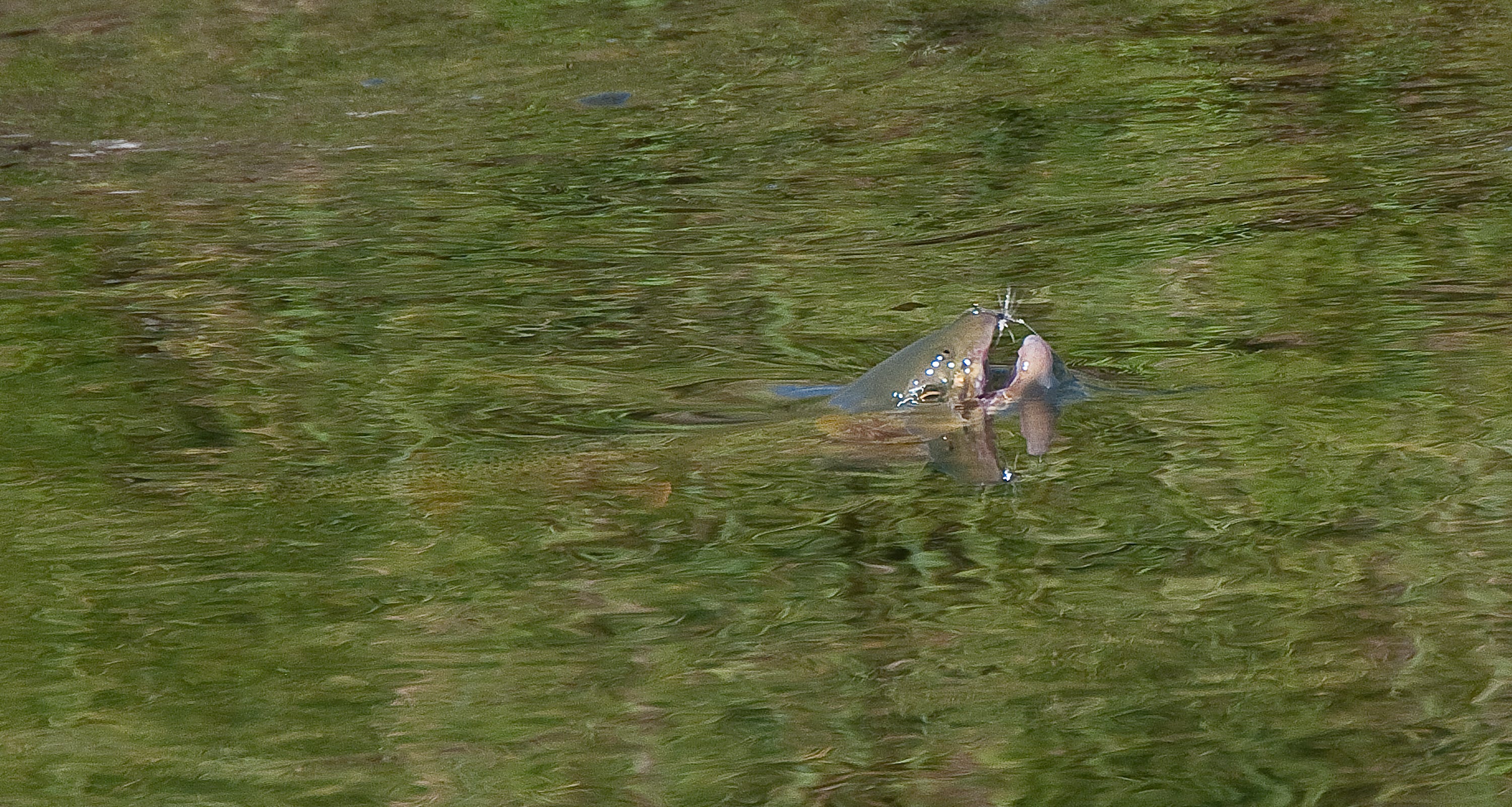
But while reviewing my photographs later that evening, my interest was immediately piqued. Quickly scanning the subsequent photos in the sequence, I realized that this fish never actually took my friend’s fly. Rather, it appears to have performed a balancing act of sorts. A balancing act intended, I believe, to determine the authenticity of a potential food item before actually ingesting it.
A few of the frames show the trout casually submerging, acting for all the world as if a fly disappearing from its lips were a common, everyday occurrence–my friend’s fly stays floating on the water, high and dry, pretty as you please. Another frame captures the line tightening as the hook was set (into thin air). Of course, this all took place in the blink of an eye and at distance. That’s why it was so easy to confuse the fly and leader riding on the lips of the trout with an actual take. Turns out that nothing was wrong with my friend’s timing or reflexes. Given that the fly never entered the fish’s mouth, he simply had no chance.
There’s no doubt that trout in heavily-fished waters often know when they’re being fished for. Their guard goes up. Their bodies tighten. They may continue to feed, but in doing so they exercise great caution (which is why a stealthy approach and a good first presentation count so much, even when fishing for cutthroats).
This particular fish knew we were there, knew we represented danger and was invoking a learned behavior to protect himself. (How it was that he was able to treat the natural flies differently than the artificials, I wish I knew.)
Numerous times I’ve sworn, as many readers will have, that a fish appearing to take to my fly actually did not take it, despite appearances to the contrary. Until this incident I could never be dead sure that such a thing happens. But now that I’ve got a few pictures, I know that it can and does. And the true significance of these images has finally come clear to me.
I mean, who doesn’t need a better excuse for a missed fish?
John Juracek is a fly fisherman, writer and photographer from West Yellowstone, Montana. For twenty-some years he was a partner at Blue Ribbon Flies, a local fly shop, and is currently the head casting instructor at the School of Trout and Anglers Academy. His writing credits include Yellowstone: Photographs of an Angling Landscape, Fly Patterns of Yellowstone, Fishing Yellowstone Hatches and Fly Patterns of Yellowstone, Volume Two.
He is considered one of the sport’s expert fly casters and instructors and offers casting lessons for $100/hour at jjuracek@gmail.com or (406) 640-2828.
I heartily endorse blaming the fish for missed strikes!